
Big Tech Incremental ROIC Analysis - META
How I learned to stop worrying and love the AI DC spend.

Disclaimer: This post is not financial advice, and is not a solicitation to purchase or sell any securities. For more info, please review the disclaimer.
Big tech is spending hundreds of billions of dollars a year on AI. This is the fundamental driver for NVIDIA’s dominance and ascension to the most valuable company on the planet. While these capital expenditures are widely talked about, there are many concerns that the transition from relatively capital-light to capital-intensive business models will cause a huge bubble and shareholders will lose lots of money.
META is one of my favorite positions at the moment and is currently being punished for a huge ramp up in capital expenditures (Capex) that management thinks is necessary to compete and grow in this AI boom. While the stock price has come down, Meta’s growth continues to be very strong. In this most recent quarter, Meta grew revenue 33% y/y. However, this doesn’t tell us whether the huge increase in capital expenditures is a good investment so I did some analysis.
The key metric is Return On Invested Capital – ROIC for short. ROIC is typically defined as:
EBIT or operating earnings is the money a business earns from its ongoing operations, after all variable costs, overhead, etc. but before any financing or tax considerations. Invested Capital is all the money invested into the business by people who have claims on cash flows from the business.
If I spend $100 on a lemonade stand and make $20 before interest and taxes each year, then I have a 20% (20/100) return on invested capital. If I’m considering opening another lemonade stand with similar returns, I can compare this to the return I would get from other projects like investing in the stock market or opening a hot dog stand.
People’s standards for a good ROIC can vary, but financially a bigger number is always better, and generally big tech companies have been characterized by impressively high (at least 20%+) returns on invested capital in their business. The downside, if you can call it that, is that these companies have been so profitable that they can’t find good investment opportunities to reinvest all their cash each year!

If we look at this table, we can see META’s invested capital has doubled in two years, from 2023 to 2025. Also, while the ROIC is still excellent it is trending downward and has fallen significantly from 2019’s 92% level.
With META planning to spend $135 billion this year, growing their existing invested capital by more than 50%, investors are nervous about the prospective returns. $135B in 2026 is almost double the $70B META spent on Capex in 2025. Visions of Reality Labs’ $80B+ of losses and counting are swimming in front of investor’s eyes.
A more careful analysis looks at the incremental invested capital. Perhaps META was a good business in the past, but is now wasting lots of money on bad ideas, and so the company’s overall return on invested capital is going down.
When looking at incremental invested capital, it’s important to remember META must spend money first, and then later on the equipment is put into production and actually earns a return. Meta is buying chips from NVIDIA, buying land, constructing buildings, purchasing servers and finally turning on the actual data centers. The project has to be powered up and operational before META can start earning money from these assets. Generally the lag time from expenditures to making money is about one year.
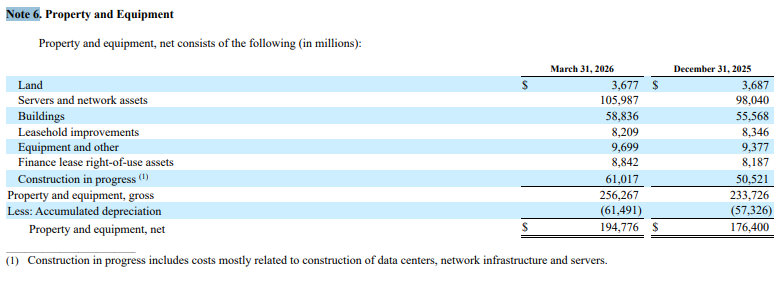
One way we can corroborate this one year time lag is by looking at META’s Construction in Progress, which is money they’ve spent (Capex) but the project is not finished and thus not producing any return yet. $61B is ~90% of the $70B META spent on Capex in 2025, or roughly 10-11 months of Capex.
We analyze incremental return on invested capital by looking at how much META increased their invested capital in a time and then see how much META earned a year later. On $25B of Incremental Invested Capital that META invested in 2024 they earned 14B in 2025 for a 56% ROIC. While lower than the past 5 years, this is still a great return. At these sort of rates, I hope META spends all their money on Capex!

Turning to the most recent quarter, we can see that in the 12 months ended 3/31/25 Meta invested $32B and then earned $5.3B in incremental operating income in Q1 26 for an annualized return of 67%. If you just look at Q1 25 Capex, they invested an incremental $10B that quarter, and due to the aforementioned $5.3B in incremental operating income for Q1 26, earned 55% on just Q1 25 Capex.
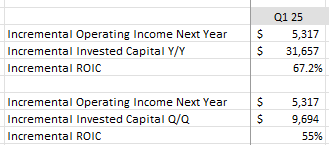
Overall, no one knows what ROIC META will earn on their current Capex. Most of the past year’s Capex is still Construction in progress and not earnings revenue / profits. However, META has a long track record of excellent returns on invested capital and the recent trends in incremental ROIC are both 50%+ and above the overall ROIC of the company! Finally, if Capex proves to be disastrous (generating very low ROIC), I am not overly concerned. This is discretionary growth Capex that META could quickly halt if they aren’t seeing returns. However, you need to believe that META won’t just incinerate hundreds of billions regardless of the economics, and given their Reality Labs history that can be difficult for investors.
Appendix:
Here’s a BBG enabled spreadsheet with some of my ROIC analysis if you’d like to dig in further.

As you says we don't what their returns will be on the current AI spend. Historical ROIC doesn't tell us much and as you say they've incinerated money before. So what's the argument for their AI spend resulting in high returns? I don't see any.
Imo it's more useful to consider what they are investing in and how that's supposed to generate more revenue/profit. And then also consider how much profit they need to make for this amount of CapEx to be worth it. That's gonna be a pretty big number..