
Big Tech ROIC Analysis - AMZN
Quick excel model and thoughts on AMZN's stated Datacenter IRR.

Disclaimer: This post is not financial advice, and is not a solicitation to purchase or sell any securities. For more info, please review the disclaimer.
If you missed it, here is part one:
Big Tech Incremental ROIC Analysis - META
Disclaimer: This post is not financial advice, and is not a solicitation to purchase or sell any securities. For more info, please review the disclaimer.
And part two:
Big Tech Incremental ROIC Analysis - GOOGL

Disclaimer: This post is not financial advice, and is not a solicitation to purchase or sell any securities. For more info, please review the disclaimer.
On Amazon’s Q2 2026 earnings call, Andy Jassy gave the following project-level IRR breakdown:
If the demand isn’t there, we won’t spend the capital. For servers and networking equipment, on average, it takes a little less than 3 years to break even on that investment. The servers currently have a useful life of at least 5 to 6 years. And most of our AI capacity these days is being contracted for at least 5-year terms. That means that we’re driving significant free cash flow on the servers and networking equipment in the 2 to 3 years after we break even.
Mostly Borrowed Ideas has a great write-up on AMZN’s earnings that I highly recommend.
However, many people are not convinced, claiming these project IRRs are not that attractive if you do the math. Here’s one example:


The basic math is very simple and since I haven’t seen anyone do it, much less provide the spreadsheets, I did it here. If you spend $100 and have a payback of roughly 3 years with a 6-year useful life, you get like 25% IRR, given a reasonable discount rate for Amazon of 10% to 15%. It’s very positive NPV.
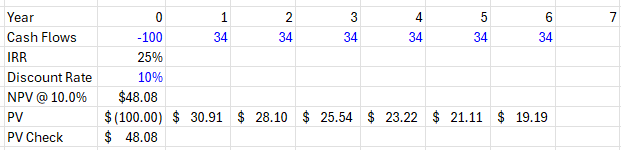
However, if you read the transcript you’ll see that datacenter spend is generally about two years before the company can start making cash flows on the project, while the majority of spend is for chips and networking equipment that are only purchased a few months before their project begins to generate cash flows.
If you assume that it’s roughly 2/3 of spend is for chips with a 6-month lead time and 1/3 is for data center with a two-year lead time, you get a weighted average of about one year. The math looks like this.

While an 18% IRR is pretty intriguing these returns are pre-tax and so this may lead to only low teens after tax returns depending on the rate. Accelerated depreciation from the OBBB makes these projects more favorable.

I’ve provided a spreadsheet with some more scenarios if you think CapEx takes longer, if you want to be more realistic and use the mid-year convention, or if you think that the useful life on this networking equipment can be extended to the 7-8 years Andy Jassy mentions as a possibility.
It’s important to note that these projections are conservative, as they assume the entire project is funded with equity instead of a significant portion being funded with debt, along with the associated lower cost of capital. Additionally, the one-third of data center CapEx with a two-year lead time should probably be a weighted average one-year lead time, as you spend throughout the two years before the data center becomes a cash-generating asset.
If you believe Andy Jassy’s project economics, assume a 2-year lead time, and no mid-year convention the lowest return is you get is a pre-tax 14% IRR with cash flows coming over the next eight years. Andy Jassy also claims that the next batch of chips and networking equipment in the data center will have even higher returns, as they don’t have to cover the initial data center construction outlay.
Of course, the risks are:
Tenants default on these five-year contracts
Significant improvements in chip technology obsolete the current investments
Future demand for data centers falls precipitously, either due to model efficiency improvements or less demand than expected, plateauing of models, more open-source models, etc. The hyperscalers are unable to earn good returns past years 5 or 6 because of a massive data center overbuild.
Overall, I think demand for AI is going to be very strong for the next few years, and the incremental returns so far have been very attractive for hyperscalers and look likely to continue while these conditions are in place. I’m sure many people will join me in monitoring these details, but for now I’m very bullish on the incremental economics.